
Marketing Attribution Models: Which One Actually Works?
 OprahDecember 16, 20251 Mins read0
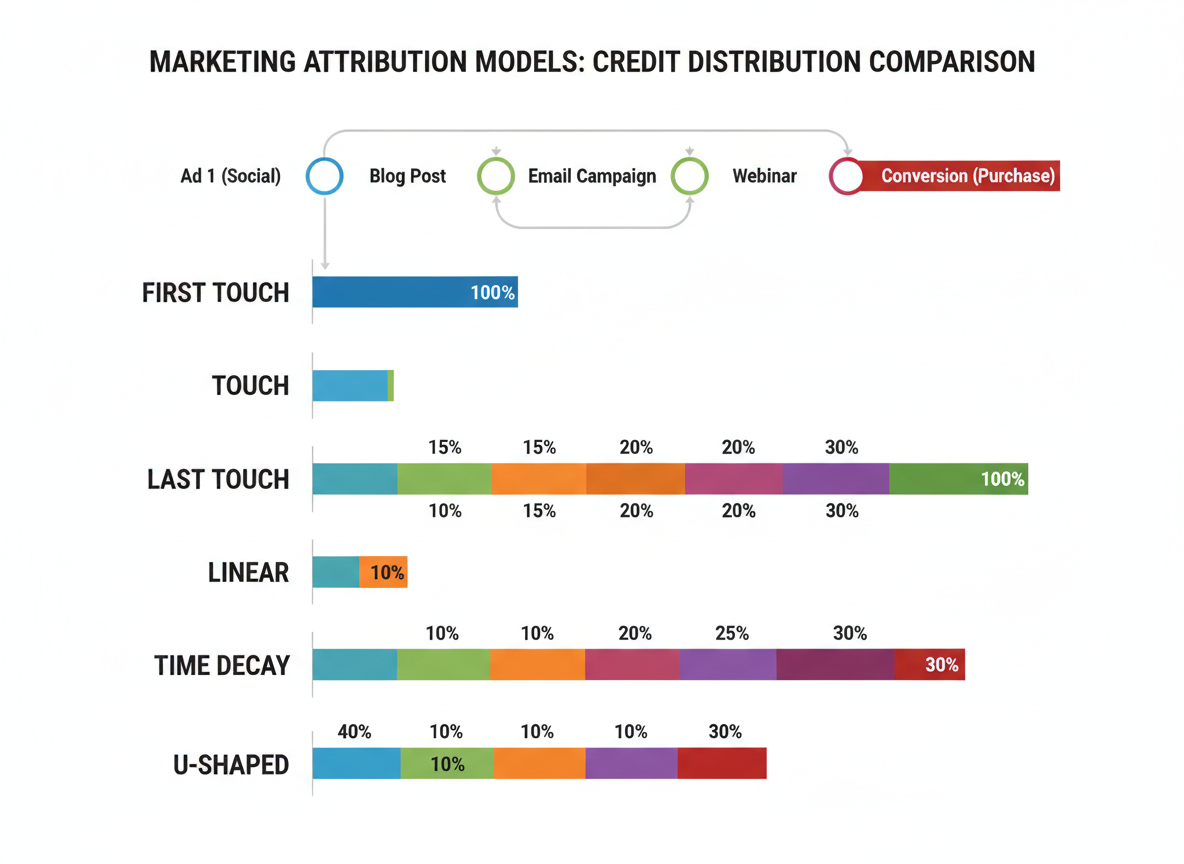
Attribution has become a nightmare for marketers. Privacy changes, cross-device behavior, cookieless tracking, and fragmented platforms make it nearly impossible to know which channels actually drive revenue. But attribution isn’t dead — it just requires smarter modeling.
The simplest model is First-click attribution, which assumes initial discovery deserves the credit. Good for awareness-heavy campaigns, bad for everything else.
Last-click attribution is the industry default but heavily flawed. It only rewards the final interaction, ignoring the 5-10 touches that usually happen earlier.
Linear attribution gives equal weight to each interaction. Balanced, but unrealistic — not every touchpoint matters the same.
Time-decay attribution prioritizes interactions closer to conversion. It’s useful for fast-moving funnels where recency matters.
The gold standard today is data-driven attribution (DDA). GA4 and most ad platforms automatically analyze user paths and assign credit based on actual impact, not arbitrary rules. DDA adapts to real behavior, making it the highest-accuracy model available.
But attribution cannot survive on website analytics alone. Offline conversions, CRM data, sales calls, and subscription renewals must be integrated for a complete picture. Multi-touch attribution requires blended insights, not siloed reports.
With the rise of privacy restrictions, marketers are adopting Marketing Mix Modeling (MMM) as a fallback. MMM uses statistical modeling to estimate channel impact even when user-level tracking is restricted.
The truth: No attribution model is perfect.
But ignoring attribution altogether guarantees wasted ad spend.
Smart marketers run multiple models, compare trends, and look at directional truth — not absolute precision.











Leave a comment