

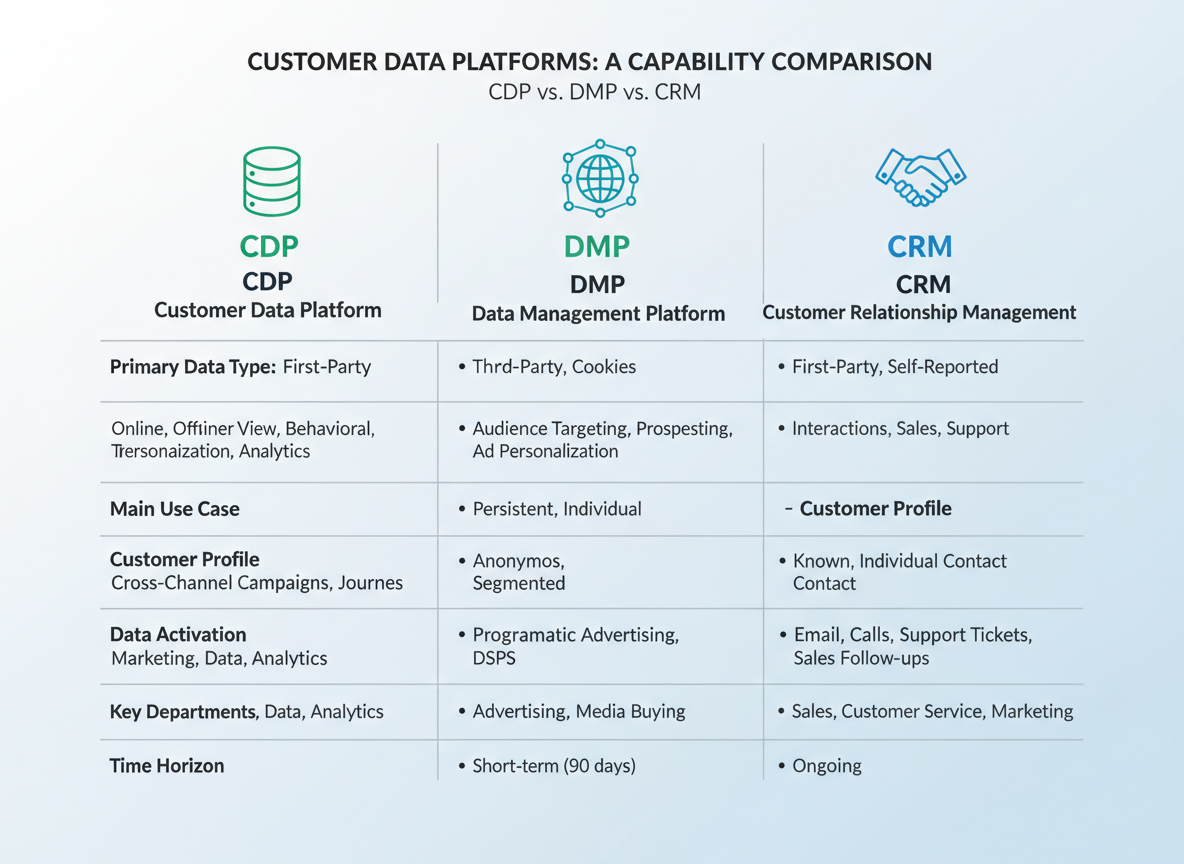
Marketers constantly confuse CDPs, DMPs, and CRMs — and vendors make it worse by mixing terminology. These three systems serve different purposes, although they all relate to customer data.
A CRM (Customer Relationship Management) stores known customer information: names, emails, purchase history, support tickets, and communication logs. CRMs power sales and service workflows, not advertising or personalization.
A DMP (Data Management Platform) specializes in anonymous audience data. It stores cookies, device IDs, and behavioral data used for programmatic advertising. DMPs were powerful in the pre-privacy era but are declining due to cookie deprecation.
A CDP (Customer Data Platform) is the modern powerhouse. It unifies first-party data from all systems — CRM, website, app, ads platforms, email, support tools — into a single user profile. CDPs resolve identities, merge fragmented data, and enable personalization across channels.
Key differences:
- CRM = sales & relationship data
- DMP = anonymous ad targeting data
- CDP = unified customer data for marketing personalization
CRMs cannot handle real-time personalization. DMPs cannot store PII. CDPs can do both — legally and effectively.
As privacy laws expand, CDPs are becoming the center of marketing data strategy. They enable AI-driven segmentation, predictive scoring, and omnichannel personalization with far greater accuracy than any single system.
For modern marketing teams, the hierarchy is simple:
CRM for sales, CDP for marketing, DMP for legacy ad targeting.










Leave a comment